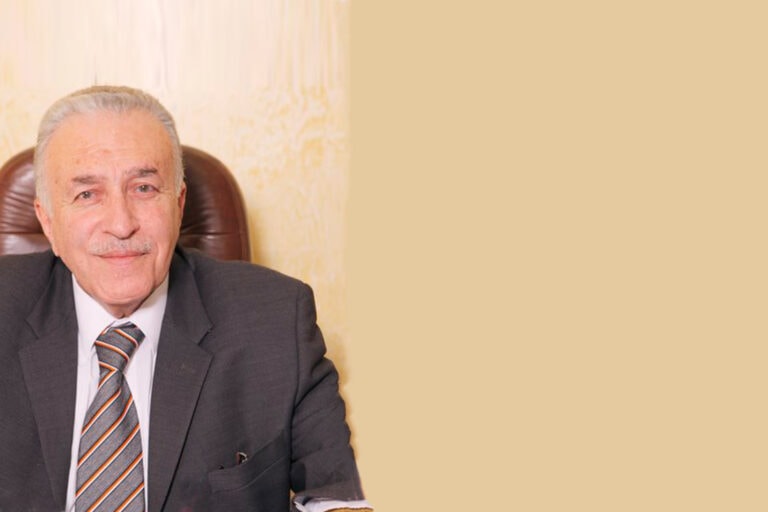
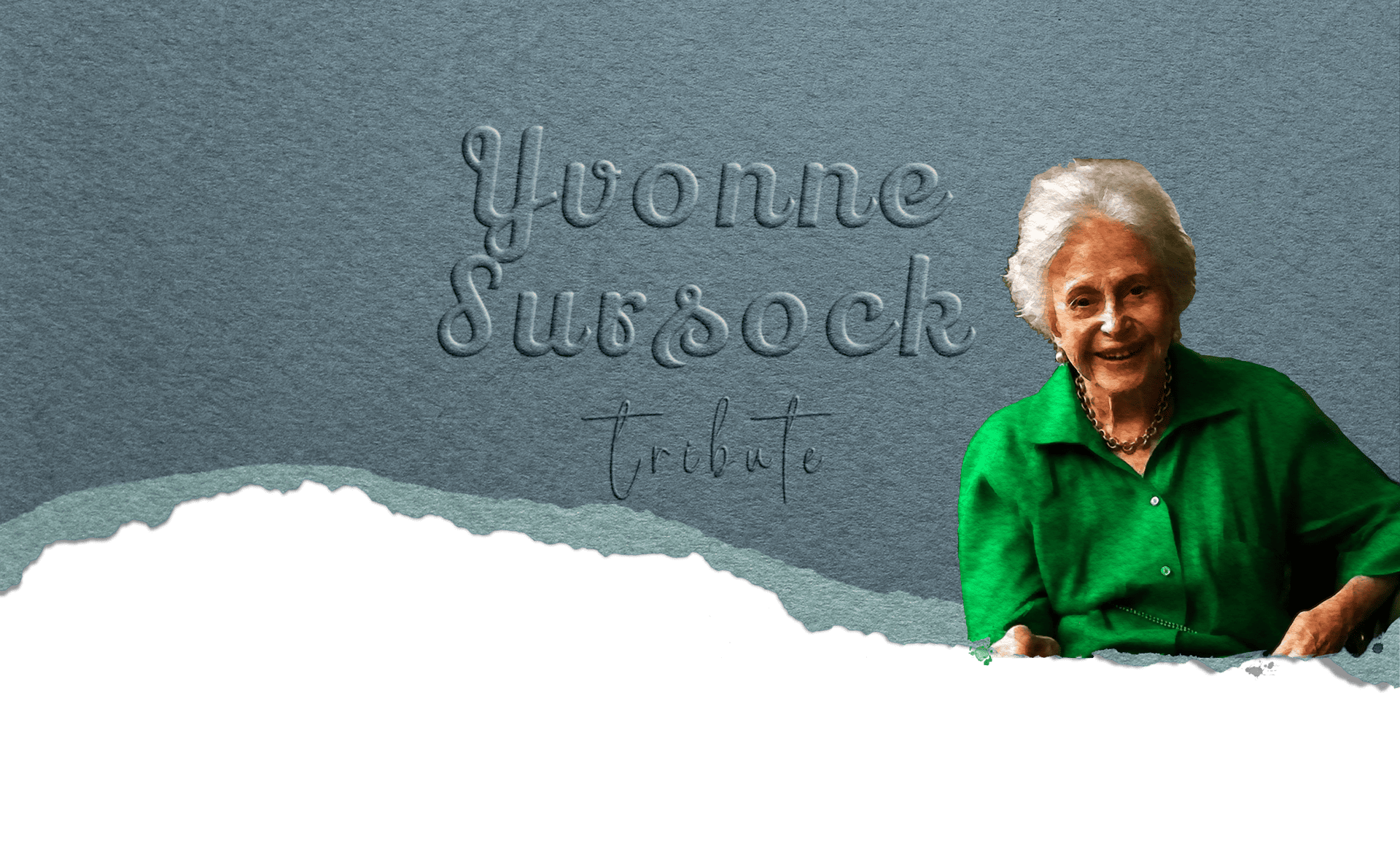
Lady Cochrane Yvonne Sursock

Tribute

advanced divider

Dateline – 31 August 2020

The last vestige of a bygone era, Lady Cochrane Yvonne Sursock passed away today at the age of 98.

With her passing, Lebanon has lost one of its greatest “warriors”.

A tireless campaigner and champion of the country’s history and heritage, a philanthropist and patron of the arts, Lady Cochrane Yvonne Sursock spent almost her entire adult life fighting to prevent the Lebanon of her childhood from being wrecked by the scourge of unregulated development fuelled by institutional corruption.

advanced divider

International Connections

Yvonne Sursock was born on 18 May 1922 in Naples, Italy.

She was the only daughter of Donna Maria Theresa Serra di Cassano, one of the 18 children (10 daughters and eight sons) of Francesco Serra, seventh Duke of Cassano.

Her father was Alfred Moussa Sursock, whose Greek Orthodox family had come to Lebanon from Constantinople and made its fortune through banking, manufacturing and land ownership. Her grandfather, Moussa Sursock, was a genius entrepreneur who contributed to the development of Beirut in the 19th century by creating an empire and building the incredible Sursock palace in Beirut.

Her parents had met in Europe when Alfred Sursock was serving at the Ottoman embassy in Paris before the First World War.

Her paternal lineage can be traced back to the 13th century – The name Sursock is said to be a corruption of the Greek Kyrie Isaac, meaning Lord Isaac, and the family is believed to have left Constantinople at the time of its fall to the Ottoman Turks in 1453.

Subsequently, the Sursocks settled in Jbeil (Byblos). In the 18th century there were Sursocks in Beirut and in the 19th they grew wealthy as tax collectors for the Ottoman government.

As landowners whose estates produced great crops of wheat and cotton, and as cotton manufacturers, they prospered even further. In its heyday the Sursock “empire” stretched from Mersin in southern Turkey, through Lebanon, Palestine and Cyprus to Alexandria in Egypt.

During a famine in Beirut in August 1918, Yvonne’s father had 58 camel-loads of wheat brought from his farms to be distributed to the city’s starving poor. He also financed the construction of, among other things, the Résidence des Pins and the Hippodrome (RaceCourse), in order to feed hungry workers and save the victims of the Great Famine (1915-18).

Following the defeat of the Ottomans in September 1918, Alfred Sursock was one of three prominent Beirutis who made the arrangements for the departure of the Ottoman governor. Later, as a member of the municipal commission and president of the “Committee of the Christians of Beyrouth”, he hosted receptions and meetings that helped to pave the way for the French Mandate of Lebanon in 1920.

By the time of Yvonne’s birth, the Sursock family’s connection to the Italian aristocracy had several strands. Donna Maria’s younger sister Donna Vittoria had married Nicolas Sursock, a cousin of Alfred’s, while another Sursock relation, Isabelle, had married Marcantonio Colonna, the head of that ancient princely family in Rome. Yvonne’s mother’s family resided at Palazzo Serra di Cassano in Naples.

advanced divider

An Upper-Class Accent

After losing her father at the young age of two, Yvonne Sursock was raised exclusively by women: her mother Donna Maria Theresa Serra di Cassano, of Italian nobility, her aunts Isabelle and Malvina Bustros, and her mother’s close friend, the Duchess of Uzès. Widowed at the age of 22, Isabelle Bustros was Alfred Sursock’s oldest sister. She had lost her only daughter when her child was 13. The girl had been named Yvonne, and it was in her honour that Yvonne Sursock was named.

She also had a British governess, to whom she owed her Queen’s English and “sophisticated” accent.

Yvonne grew up speaking Italian, English, French and Arabic. She enjoyed horseback riding, dancing and skiing.

It is true she was an only child, but with 17 Italian aunts and uncles there was no shortage of cousins, whose company she was to enjoy on regular visits to Italy throughout her life.

When Yvonne was 11 her aunt Isabelle, who was also her godmother, proposed that she be sent away to school, and as a result Yvonne was sent to board in England, at Les Oiseaux, a Roman Catholic convent school at Westgate-on-Sea, in Kent. The pupils were either English or French and Yvonne (who counted as French) noted that where the English girls always had their lacrosse sticks with them, the French girls had their books. This was not an easy time for her – there were disagreements with her mother and aunt and tears when she was shipped off to boarding school each term.

The British author William Dalrymple interviewed Yvonne Sursock for his book “From the Holy Mountain – A Journey Among the Christians of the Middle East” (1997) and described her “old-fashioned upper-class accent, the ‘r’s slurred almost into ‘w’s”.

With war in Europe looming, Yvonne was brought back to the comparative safety of Beirut, where she completed her schooling and attended university. Always full of joie de vivre and laughter, at her first big dance, which was held at the Palais Sursock, she took to the floor with her mother’s friend Prince Aly Khan as the band played Cole Porter’s ‘Begin the Beguine’, the dance classic of that era.

advanced divider

Summers in Sofar

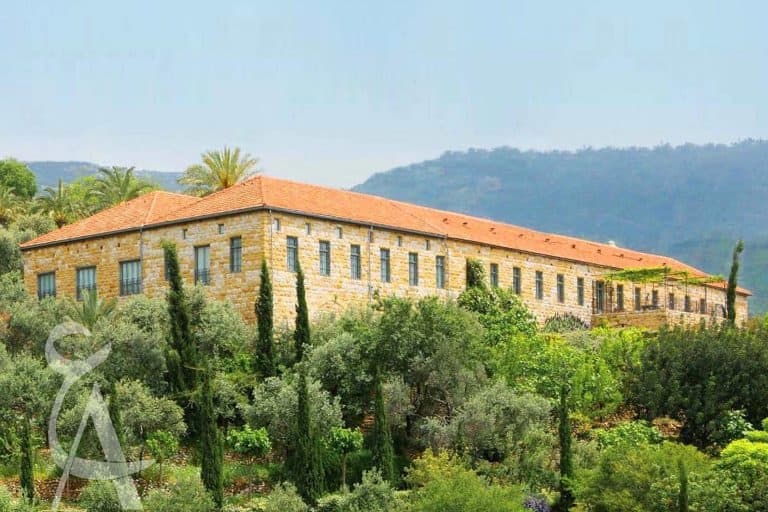
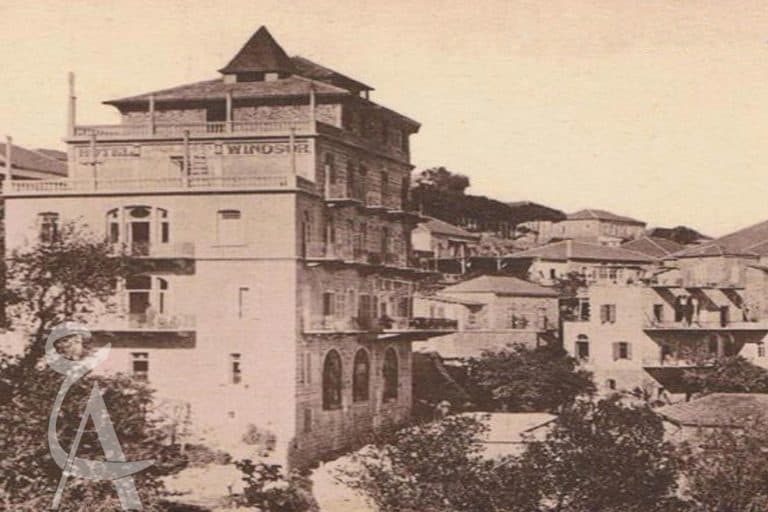
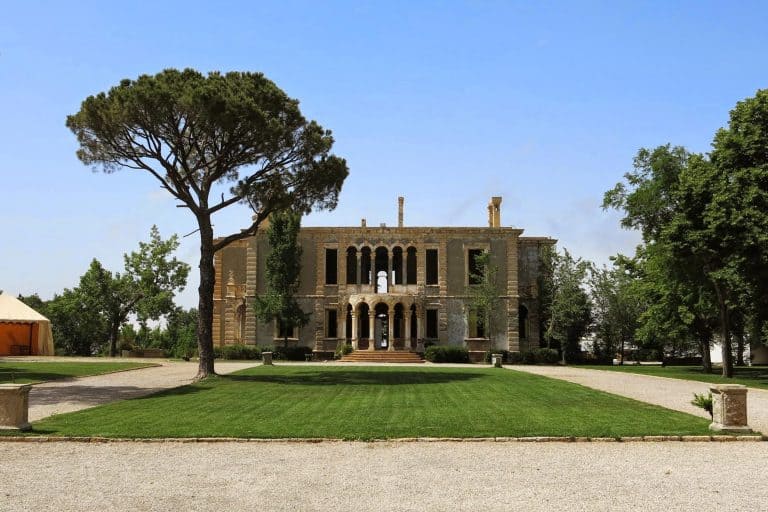
The Sursock name is synonymous with the picturesque village of Sofar. The Grand Hotel Sofar and Donna Marie Sursock Palace, both built by the Sursock families in the late 1800s, still stand today, these iconic landmarks in disrepair, but glorious nonetheless.

Donna Maria Palace was built by Alfred Sursock for Yvonne’s mother. This magnificent fairytale castle, one of its kind in Lebanon, had an esplanade where Yvonne’s mother made a floor for dancing and dinner parties. Before she was born, her father planted all the trees along the Corniche, the famous trademark of Sofar’s main road. To this day, this beautiful village is surely indebted to the vision and foresight of Alfred Sursock.

To escape the heat and humidity of Beirut during the summer months, Yvonne, her aunts and entourage would make an annual pilgrimage to Sofar, enjoying views of Lamartine Valley and Hammana from the Palace windows.

It was here, in Sofar, many years ago, that we first had the pleasure to meet with Lady Cochrane, in the restored gatehouse adjacent Donna Maria Palace, where she would retire for the hottest months of summer, enjoying Sofar’s fresh, balmy breezes, surrounded by the families she had known all her life.

During her annual summer sojourns, we enjoyed afternoon teas on the terrace, chatting and reminiscing. Lady Cochrane spoke with joy of her childhood memories of summers spent in Sofar, the glorious halycon days of the Grand Hotel, and its impressive visitors – “the who’s who of half the world came to Sofar, can you imagine?” she said.

“Sofar is still one of the most beautiful villages in all of Lebanon, one of the few that has not fallen victim to the greed of developers.”

advanced divider

Engaged & Married

In 1945, during a luncheon at the home of her cousin, Linda Sursock, she met Desmond Cochrane, a scion of the Anglo-Irish Cochrane family who served with the British army in Cairo, when he went on holiday to Beirut at the end of the second World War.

Prior to meeting Desmond, Yvonne was “very much in love” with a man killed in an airplane crash.

Yvonne told us she didn’t really notice Desmond on that first meeting (“I couldn’t quite remember who he was the next time I saw him”) but with subsequent visits, they fell in love.

Yvonne’s engagement to Major Desmond Cochrane of the Lancashire Fusiliers was announced in November 1945.

The engagement was somewhat against the wishes of Yvonne’s family, who preferred unions between cousins, but she was undeterred.

In 1946, at the age of 24 (relatively “old” by Lebanese standards at the time), Yvonne Sursock married Desmond Cochrane. They were married by an Irish British army padre at the Catholic cathedral in Beirut in January 1946.

An Etonian and Irish Baronet who was stationed in the Middle East during World War II, Desmond stayed on in the region as Honorary Consul-General of Ireland for the Republics of Syria and Lebanon.

Their three decades together proved to be entertaining. “My husband was very witty,’ she recalled. “There was seldom a dull moment.”

advanced divider

Sir Desmond Cochrane

Desmond Cochrane had been posted to GHQ Middle East Forces and in 1944 was Military Secretary to GOC Ninth Army. He was the second son of Sir Ernest Cecil Cochrane, 2nd Bt (the playwright Ernest Cecil).

Desmond Cochrane’s grandfather Henry founded the Cantrell & Cochrane (C&C) company, which earned a fortune through ginger ale and mineral water. Henry Cochrane was made a baronet in 1903. Desmond, as a second son, did not expect to inherit the title and wealth. But his older brother Henry, who fought with the Royal Inniskilling Fusiliers, was killed in a road accident in Austria in the summer of 1945, on the way back from the second World War.

When his father died, Desmond Cochrane became Sir Desmond and inherited the Woodbrook estate outside Bray, County Wicklow. He and Lady Cochrane (as she was now known) took possession of the house in 1952. From then on the family divided its time between Beirut and Ireland. Lady Cochrane also kept houses in Rome and London. Her husband went on to become the honorary consul-general of Ireland for Syria and Lebanon, and controller of Beirut racecourse. 

As Ireland’s honorary consul in Beirut, Desmond Cochrane helped Irish businesses develop trade opportunities throughout the Middle East. The family entertained lavishly, in Beirut, at Woodbrook and in London and Paris.

advanced divider

A Jet-Set Life

Glamour is a word often associated with Lady Cochrane, and deservedly so.

“My mother had the clothes. She had the jewellery. She had the house. She loved the artistic life,” said Alfred, Yvonne’s second son.

“She had everything, and she was unbelievably glamorous. Among the jet-set aristocracy in Europe, she was recognised as such.”

“My parents were attractive and fun and spoke languages. We gave the best parties in Beirut because my father, being Irish, knew how to give parties.”

The French illustrator, art historian, biographer, aesthete and writer Philippe Jullian (1919-1977), a friend of the Cochranes, published a book titled “The Snob Spotter’s Guide” in 1958. He wrote that if you want to be a really glamorous jet-setter, you had to have breakfast with the Maharaja of Jaipur, lunch with Desmond and Lady Cochrane in Beirut, and dinner with the Duchess of Alba in Seville. Such was the Cochrane’s standing.

The couple had four children – Marc manages his share of the Sursock family assets from Beirut and Cochrane assets from Ireland; Alfred is a retired architect and furniture designer; Roderick is the custodian of Sursock Palace, from where he runs his family business; and Isabelle divides her time between Italy, Ireland and Lebanon.

The Cochranes separated amicably in the 1960s. Sir Desmond moved to Cyprus. Lady Cochrane, who settled in Beirut, nonetheless wore black chiffon and mourned him when he died from a brain hemorrhage in 1979.

“When he died, she was devastated and stayed in bed all day,” recalled her daughter, Isabelle. Later, before her passing, she started talking to herself, addressing Desmond, saying “Wait for me, please. “

advanced divider

At the Helm

It took Lady Cochrane twenty years to be able to take over the family business, or rather what little was left of it after decades of disastrous management, since her mother and aunt Isabelle had delegated all the family affairs to unscrupulous managers. Since then, she no longer delegated, attending to and overseeing every aspect of her estate.

Lady Cochrane refused to leave Beirut, even in the worst days of the 1975-1990 civil war.

“She thought if she left she might never be able to come back,” said son, Alfred. “She adored Lebanon but she was heartbroken by the way the Lebanese were destroying it.”

advanced divider

APSAD is Born

In 1958, the couple’s friends in Ireland, Desmond and Mariga Guinness, established the Irish Georgian Society to protect and conserve classical homes from demolition.

Like buildings constructed in Beirut during the Ottoman era and under the French mandate, Ireland’s Georgian homes were at risk from zealous developers eager to bulldoze and knock down the structures and replace them with apartments and offices.

“When things started getting rather nice in Beirut in the late ’60s, my mother realized that wonderful whole streets were being pulled down,” said son, Alfred. “She felt she had to do something, having been inspired by Desmond and Mariga.”

Lady Cochrane used to live on the top floor of her palace, which is set on a hill above Beirut’s harbour, in the heart of Achrafieh district, and one of the great joys of living there was the view of the port and the sea, a view she had known all her life, having lived at the Palais Sursock from early infancy.

It was a view so beautiful, she remembered, that it took one’s breath away.

Then one day, when surveying the scene from her upstairs window, Lady Cochrane thought to herself: “I’m not breathtaken. What has happened?”

She realised that the green spaces were disappearing, that buildings were rising rapidly, that the Ottoman garden city of her youth was being destroyed. Something, she felt, must be done to stop the rot, and APSAD was the result.

In 1960, Lady Sursock established in Lebanon an association known as Association pour la Protection des Sites et Anciennes Demeures au Liban (APSAD) to conserve Lebanese architecture and heritage structures.

“The history of Beirut was being demolished right in front of our eyes, and nobody wanted to do anything about it. I realised that if I didn’t take action, nobody would. We certainly couldn’t rely on the government. I couldn’t just stand still and watch the destruction,” said Lady Cochrane.

Lady Cochrane secured the support of Emir Maurice Chehab, a well-known archaeologist and head of Lebanon’s Directorate General of Antiqui­ties at the time.

“He was a civil servant with a certain amount of power and he could use some of his power to list buildings in Lebanon that needed preservation,” said Alfred Cochrane.

APSAD, an organisation that has been compared to the National Trust in Britain, fought against developers  who took advantage of the lack of planning and environmental controls to bulldoze Phoenician and Roman ruins and historic Ottoman-era buildings, replacing them with skyscrapers.

Despite its successes, Apsad’s mission to preserve old sites and buildings in Lebanon was greatly undermined by the civil war. Such things as preservation orders command little respect in wartime, and afterwards are easily ignored or overlooked. Sky-rocketing land values in Beirut, where land suitable for building was always in short supply, was another factor mitigating against the achievement of Apsad’s objectives.

Lady Cochrane was always fighting an uphill battle, but never relented.

A philanthropist and patron of the arts, Lady Cochrane Yvonne Sursock was not only committed to the protection of cultural and historical sites, but also to innovative social projects that helped to preserve the social fabric of rural Lebanon by encouraging people to return to the countryside.

“I don’t understand today’s obsession with university education, everyone seems to want their children to be doctors and dentists. The world needs chefs and carpenters and builders and people to work on the land – these are equally as important, equally as valuable. What would we do without these?” she told us.

Her family spoke of her not as a campaigner but as a “warrior”, a petite and elegant woman of considerable intellect who worked relentlessly for the causes in which she believed but who was not blessed with that critical faculty in Lebanon, the art of compromise.

Others have called her the “Queen of Beirut” and the “Jeanne D’Arc” of Lebanon’s cultural heritage, a woman whose faded elegance in later life seemed to sum up all that had been lost in a city once celebrated as the “Paris of the east”.

Articulate, outspoken, with a dry wit, she referred to her beloved home city in recent years as little more than a “junk yard” that had become the victim of a chaotic and profit-driven “archaeological massacre”.
 

advanced divider

Destruction of War

Closer to home, while developers spoilt the view from the Palais Sursock’s windows in the 1950s and 1960s, during the following two decades war threatened to destroy the palace itself. Built for Lady Cochrane’s grandfather in the 1860s, in the style of an Italian Baroque mansion, the palace was caught in the line of shell fire a number of times, receiving a particularly severe battering in 1976.

Lady Cochrane was in another part of town at the time and, despite some serious damage to the building – a wall of the library was blasted away by a phosphorous bomb, leaving a bookcase standing upright against the sky; a mirrorwork ceiling was brought down; a chandelier was blown apart; Sir Desmond’s collection of Chinese porcelain was destroyed – she returned home to find the palace largely intact.

“I suppose we were very lucky that none of the shells cut the main load-bearing pillars,” she remarked to the author William Dalrymple, “otherwise the whole thing would have collapsed. But by pure good fortune most of them went straight through: down the passage, into the dining room and out the other side into the garden. Ruined my borders. Holes everywhere.”

At times during the war, she recalled, mortars had come “whizzing through the house six at a time”; but notwithstanding such annoyances, and the drawbacks of living in a bomb-damaged house – it was not until 1985 that it seemed worth attempting restoration – there was no question of leaving. “You cannot abandon your country when it’s on its knees,” Lady Cochrane said.


advanced divider

Outspoken & Fiesty

Lady Cochrane Yvonne Sursock was outspoken and fiesty, never afraid to voice her opinions.

On France’s achievements in Lebanon – “A catastrophe, which emptied the mountains of their people, agriculture, and industry by centralizing all activity in Beirut.”

On the phenomenal growth of Beirut in the 20th Century – “An anarchy of concrete and pollution which destroyed the beautiful urban fabric and the surrounding sea.”

On the reconstruction of Beirut after the war – “A heresy that has destroyed historic buildings by the hundreds.”

On the political class – “They control everything and are leading the country to ruin, there is no place for young people here.”


advanced divider

Sursock versus Solidere

After the civil war, in the late 90s, Lady Cochrane returned to the fight, this time focusing her ire on the prime minister, Rafik Hariri, and his Solidere company that redeveloped swathes of the Beirut central district. This was carried out often at the cost of heritage buildings and ancient souks that were compulsorily purchased and destroyed to make way for new developments.

Lady Cochrane fought a very public battle with Hariri, memorably describing Solidere as a “bandit organisation” and the “dream of a retarded adolescent”. She railed against his plans that cut off the centre of Beirut – a city, she once remarked that “lives by the wind that comes from the sea” — from the bay on which it was built.

APSAD conducted an international campaign against Hariri’s most ambitious remodelling and in the end he was forced to back down and the plans were altered. As a peace offering to his foe, he sent her a signed copy of his book Beirut Reborn, in which he had written: “I hope you are satisfied.”

“Were you satisfied?” we asked her, when she told us this story. She gave a wry smile. “Well, it wasn’t a victory, but it was certainly better than nothing.”

She was not unhappy with the restoration work he had done; but surveying Beirut overall was increasingly glum. “Beirut has become an enormous slum,” she said. “You go from one hideous place to another.”

“Downtown Beirut was a terrible tragedy. Beautiful houses were being pulled down all the time and APSAD campaigned virulently against this. The Germans for some reason took up the cause too and they produced a film that lasted one hour about the destruction of Beirut by Solidere – Mr. Rafic Al Hariri, in other words. That of course upset Hariri enormously.

“But he was a very intelligent man and he realised he was probably going the wrong way. He then reversed his policy and instead of continuing the destruction of houses, he restored them and he restored them quite well.

“And before he died he said, ‘What a pity I have destroyed so many houses, because the only place where the tourists go, where even the Lebanese spend the evening and so on, is in Downtown where I have not destroyed the houses and instead restored them’.”

Beyond Beirut, Apsad had some notable successes in helping to preserve Lebanon’s heritage. Hammam al-Jedid, the great Ottoman bath-house in Tripoli, was completely restored. The restoration of the old souk, the town hall and the church of Mar Youssef in Jounieh was funded or part-funded by Apsad. Ancient sites at Enfeh were, thanks to the association’s efforts, placed on the watch list of the World Monument Fund.

“When I was a child, Beirut was one of the most beautiful cities in the Mediterranean,” she recalled. “Look at it now. It’s an enormous slum!”

“I was very democratically-minded when I was young,” she said. Her beliefs changed as she observed her country’s evolution. “Democracy does not provide rulers. The whole system is an ideal, but it does not work.”

advanced divider

A Cultural Battlefield

Lady Cochrane’s cultural commitments were wide ranging. She was a founder member of the Baalbeck Festival in the Fifties that brought inter- national theatre, ballet and orchestral companies to Lebanon every summer to perform at the Temples of Baalbek. She was also a founding member of the Jeunesses Musicales du Liban, an organisation dedicated to helping young Lebanese to learn about and play classical music, and a trustee of the Sursock Museum, a modern art collection in an ornate villa in Beirut that was bequeathed to the nation by her uncle Nicolas on his death in 1952. It was re-opened in 2015 after undergoing restoration but was seriously damaged in the massive explosion in the port area of Beirut on August 4, 2020.

In the field of urban planning, Lady Cochrane could point to many significant achievements but she was fighting a losing battle. Her eldest son, Sir Marc Cochrane, said that he believed her innate stubbornness and refusal to accept opposing points of view counted against her.

“Compromise was anathema to her,” he said. “She was all too often beating her head against a brick wall and, in many instances, was not able to circumvent the hurdles in order to achieve her objectives.”

advanced divider

Final Farewell

On 4 August 2020, 2,750 tonnes of ammonium nitrate stored at the port of Lebanon’s capital city, Beirut, exploded. The resulting blast caused at least 204 deaths, 6,500 injuries and left an estimated 300,000 people homeless. Tremors from the huge explosion were felt as far away as Turkey, Syria, Israel and Palestine – even in Cyprus, more than 240 kilometres away.

The explosion was one of the most powerful non-nuclear explosions in history, and Lebanon’s investigation as to its occurrence is still at an unforgivable standstill, so many years after the disaster.

Among the many tragic casualties was the venerated philanthropist, Lady Cochrane Yvonne Sursock. The doyenne of Beirut society since the 1960s, Lady Cochrane died aged 98, a month after the blast, from injuries sustained.

At the time of the blast, she was taking tea with friends on the terrace of her home, Palais Sursock, the 160-year-old Beirut landmark in Ashrafieh.

She was thrown several metres by the blast and suffered cuts and bruises as well as internal injuries.

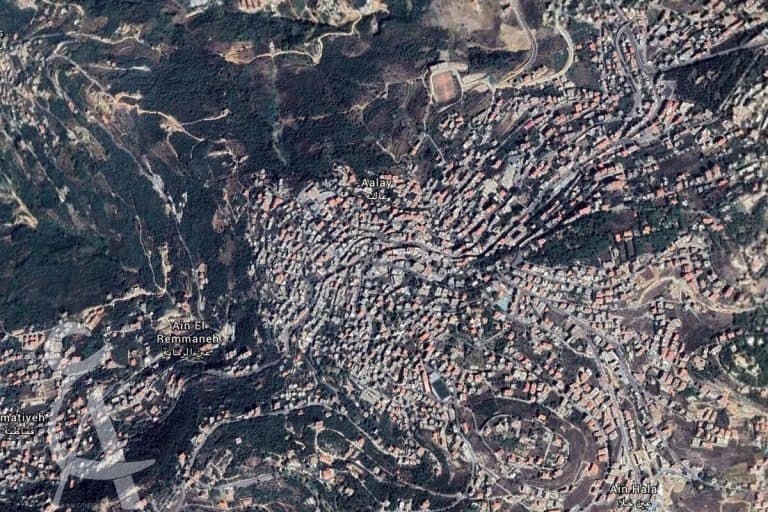
With hospitals in Beirut overflowing, Lady Cochrane received treatment in Aley, before retiring to Sofar to recouperate.

Lady Cochrane was born just two years after the French proclaimed the État du Grand Liban in 1920, and died on the eve of the centenary of its creation, when many were predicting the death of the country. She seemed to personify the splendour of a rich and long-lost Orient. 

Lady Cochrane had never given up in the face of adversity. The day after the explosion, she said: “It does not matter, we shall rebuild,” recalled her daughter, Isabelle.

“Four days before her death, she had recovered, so she called her assistant, announcing that she was going to work on a plan to build a public garden.”

Yvonne Sursock had been one of the first to dismiss Lebanon’s political class as crooks and scoundrels. Her children contemplated writing “no politicians allowed” on her funeral announcement. When a representative of the Lebanese president showed up with a giant wreath and a posthumous National Order of the Cedar medal, he was collared by her grandson Patrick. “You killed my grandmother,” he said.

She is survived by sons Marc, Alfred and Roderick, daughter Isabelle, seven grandchildren and six great-grandchildren.

We salute you and we bid thee farewell, Lady Cochrane, Yvonne Sursock. Lebanon is forever indebted to your noble pursuits. Alas, there will never be another Lebanon like the Lebanon of your youth, like the Lebanon you fought so valiantly to preserve and protect for future generations. And there will never be another like you, of that we are certain.

advanced divider

Tribute - Chris Rampling

Chris Rampling, the British Ambassador to Lebanon from September 2018 to December 2020, penned these words:

advanced divider

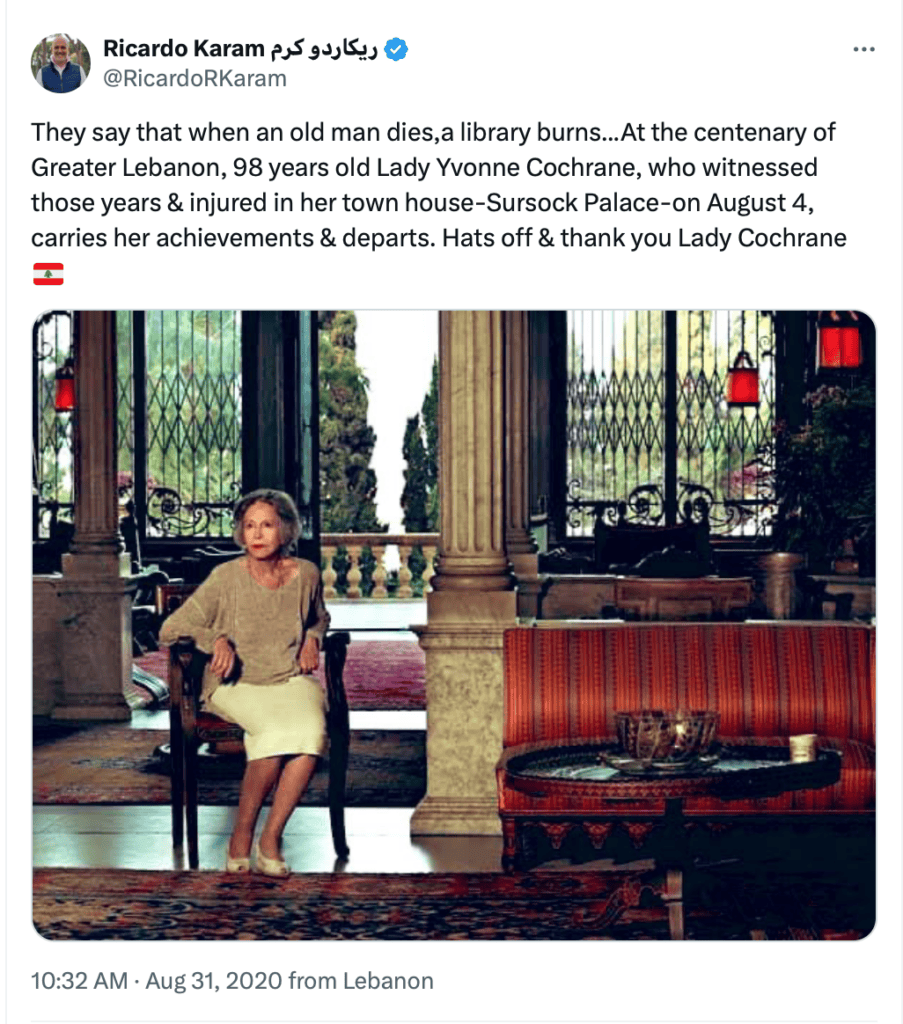
Tribute - Ricardo Karam

Journalist Ricardo Karam paid tribute thus:

advanced divider
City of Aley

More Tributes

advanced divider
City of Aley

اكتشف عاليه

advanced divider
City of Aley

دليل الاعمال

advanced divider
City of Aley

الاحداث

advanced divider
arالعربية