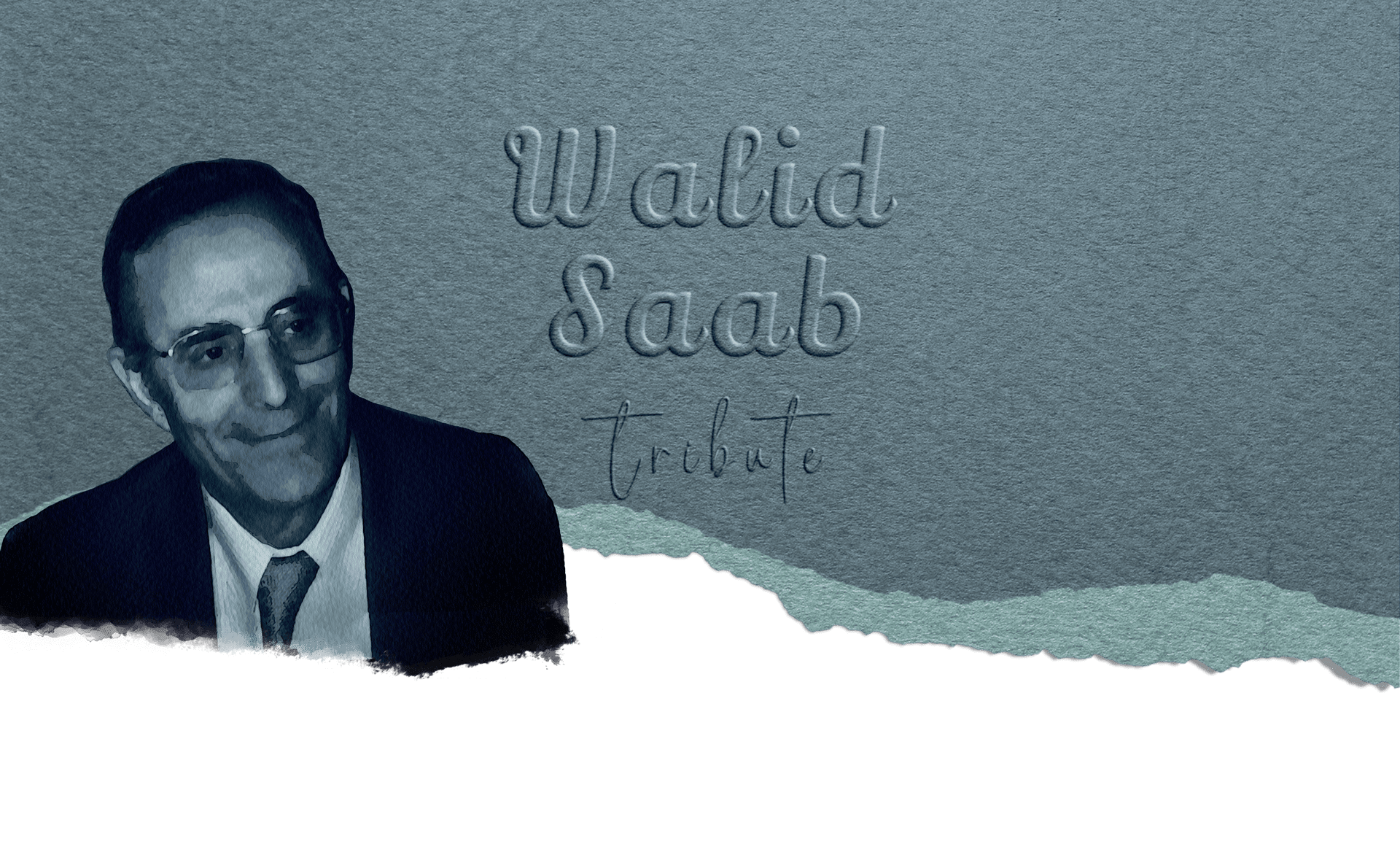
It is with great sorrow that we announce the passing of the writer, journalist, critic, archivist and activist, Walid Saab Shmait, born in Aley on 15 October, 1942.
Walid Saab was my friend, my cousin, a man of rare intellect and rare integrity – humble, unassuming, and yet a pioneer in his field.
In a world of self-promoting academics, coining buzzwords and jumping on the next populist bandwagon, Walid Saab Shmait stayed true to his cause and his convictions, a quiet achiever unswayed by commercial gain or glory, pursuing his lifelong passion for the cinema and remaining staunch and steadfast in his support of the Palestinian plight.
Walid Shmait belonged to an elite group of intellectuals, for whom intelligence was the chosen weapon of activism.
For Walid Shmait, the cinema – more specifically, Palestinian, Lebanese and Arab cinema – was a passion, an obsession, an addiction, to which he devoted most of his life’s work. And in this regard, his achievements remain as a legacy for generations to come. It is a legacy which will never die, and will forever leave its imprint on the Lebanese and Arab cultural landscape.
Walid Saab Shmait enjoyed his first taste of cinema as a young man, growing up in Aley –the summer resort village which, at the time, was known as “The Bride of Summer” and boasted some eight cinemas.
In the late 1950s, he moved to Sao Paulo, Brazil. There, he watched the movie “Adventure” by Michelangelo Antonioni – and was hooked forever by this magical world of stage and screen.
In his media interviews about his relationship with cinema, he mentioned that he was an expatriate in Brazil, and it was there that he discovered cinema, and was also given the opportunity to work in a theatre in Sao Paulo.
When he returned to Lebanon, he found himself a critic and filmmaker. He also found himself in front of the camera – he played roles in “Sayyid Taqaddumi” by Nabil al-Mallah, “The Model” by Tunisian Sadek Ben Aicha, and “The Head” by the Iraqi Faisal Al-Yasiri.
Walid Saab Shmait worked as an assistant director and production manager on a number of Lebanese, Arab and foreign films between the late 60s and late 70s. With the efforts of Paul Tannous, he presented the programs “History of Cinema in Lebanon” and “History of Cinema in Egypt” on Tele Liban.
This allowed him to conduct interviews with a large number of Lebanese and Egyptian filmmakers and critics alike – among them were the greats who founded cinema in Lebanon and Egypt, including Maroun Baghdadi, Salah Abu Seif and Burhan Alawieh.
He introduced the public to our great cinematic heritage, collecting archives that documented a previously neglected aspect of our history and culture.
In a recent interview before his passing, he mentioned that he hoped that the archive of the program would be preserved in the library of Tele Liban.
Although the cinema was his greatest passion, along with his concern for the Palestinian cause, his work was not limited to such. He also became involved in politics through his work as a media advisor to the Secretary-General of the League of Arab States during the reign of the Tunisian Chadli Al-Qalibi.
Walid Shmait was also a cinema activist, and in 1974 he founded the Arab Cinema Club with a group of critics, writers and cinema enthusiasts, which became one of Beirut’s landmarks, between Corniche Al-Mazra and Hamra. It was the first club to discuss films in the Arabic language. Under his directorship, the Club hosted the famous Italian poet/film director/writer/actor/playwright/intellectual Pier Paolo Pasolini, on the occasion of the screening of his film, “The Pig Pen”.
He was also able to make documentary films during the Lebanese civil war.
Walid Shmait wrote a book about director Youssef Chahine entitled “Youssef Chahine and a Life for Cinema” (Riad El-Rayess Publishing House), with whom he enjoyed a close friendship.
The book is in two parts – the first contains Walid Shmait’s critical opinion of Youssef Chahine and his cinematic worlds, while the second section presents Youssef Chahine’s own vision for his films.
In an interview with “An-Nahar” he spoke about his book:
“I was keen to highlight Youssef Chahine’s personality as a human being through his films, because he is one of the few Arab and international filmmakers who films cannot be separated from their personalities. He is himself, he and his films, his cinema speaks of his concern and his world, and I was keen to show this aspect in the book, as I was keen to address the topics that occupied Youssef Chahine and focus on them and remind the reader of the recurrence of those topics in his films in order to present a general idea about Youssef Chahine as a human being, a creative filmmaker and a thinker.”
He was also the author of the book “Palestine in Cinema”, a translation of most of the content of another book published in French in early 1977, entitled La Palestine et le Cinema, as a collective work supervised by French critic Guy Henbel and the Tunisian critic Khamis Khayati. Walid Shmait translated most of the book, added information to it, articles and interviews, and published it in Arabic in 1978. He considered that the printing of such a book in the Arabic language was an integral and essential part of preserving Palestinian identity and culture.
He considered this one of his most important books, and nearest to his both his heart and mind.
In 2006, the book was reprinted by the Palestinian Ministry of Culture, but in a haphazard fashion, with many disappointing errors. Last year, justice was served – the book was re-issued in a new edition that accompanied the ninth edition of the Palestine Film Days Festival, giving new life to this important reference work regarding Palestinian cinema, almost half a century after its first publication.
In his introduction, Salim Al-Beik (editor of the book in its new edition) wrote that Walid Shmait’s book is a ‘“comprehensive answer to what Palestinian cinema was like, and it is the most important and comprehensive collected document in its archival nature.”
Among his other works is ‘The Man of Construction in the Time of Destruction” – a biography of the property developer Raja Saab (1927-1988).
He also wrote “The Empire of the Neoconservatives … Media Misinformation and the Iraq War (2007-Dar Al Saqi). The book deals with the policy of misinformation in the war against Iraq, and reviews the tools and methods that were used to justify this war.
Recently, he was preparing a book about the cinematic and humanitarian project of director Burhan Alawieh.
Tribute - Rafif Fattouh
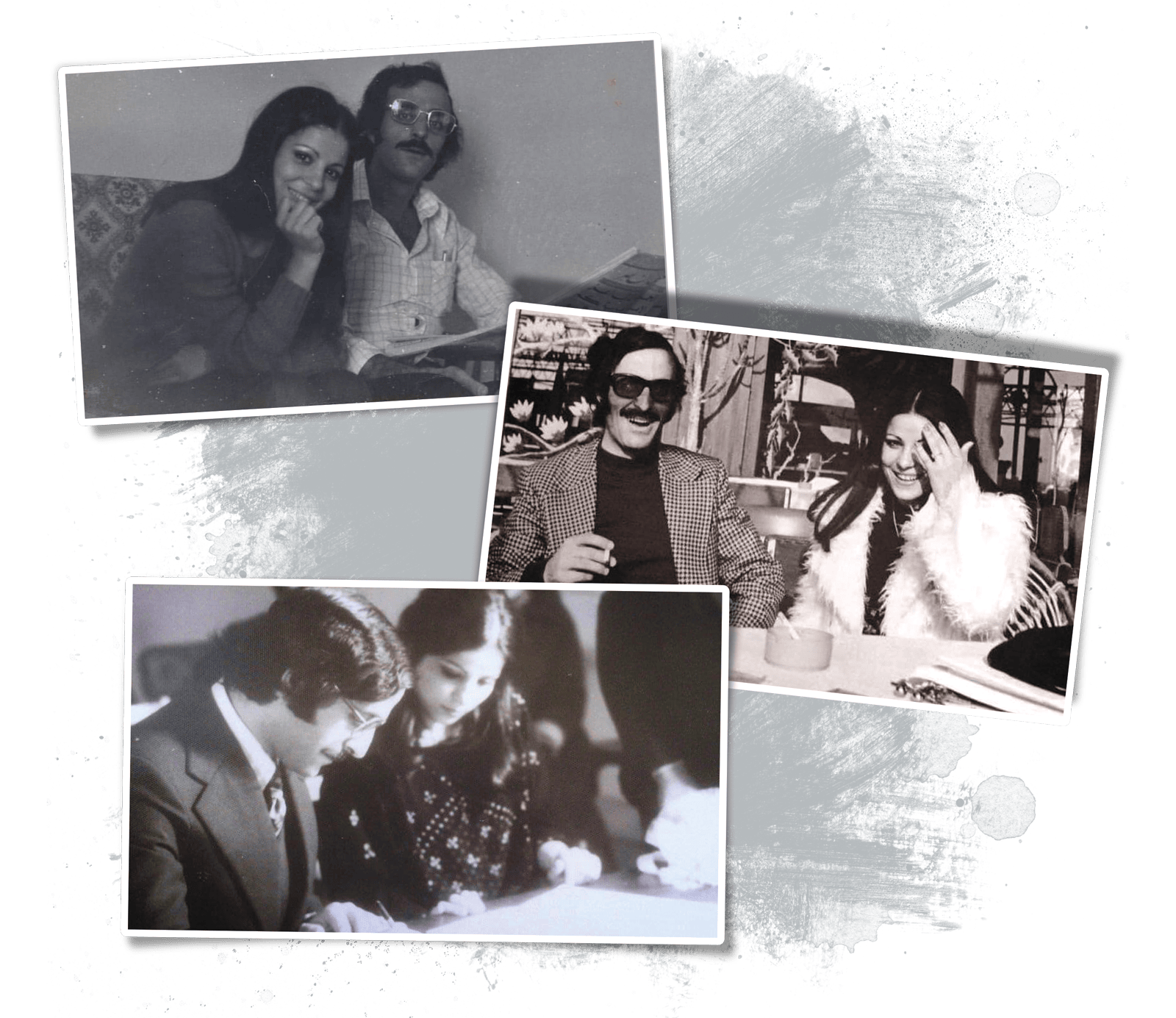
Walid Shmait’s wife and soul-mate, the artist/poet/journalist, Rafif Fattouh, penned this emotional tribute to her husband:
“Goodbye, my love of my heart, my life and all my memories. Life has an expiration date, but love never ends, never dies or goes away. How can someone who lives in my heart die? How horrible death is, how difficult separation is. Farewell Walid.”
WALID SHMAIT & RAFIF FATTOUH
Tribute - Kamal Tarabay
The journalist Kamal Tarabay wrote this tribute to his longtime friend and colleague:
“How saddened I am by your departure, Walid. A lifelong companion on the path of searching for a stolen homeland and for absent justice. Your cultural career was crowned by revising and pubishing the book “Palestine in Cinema”. You were a pioneer and professor of film criticism. Our paths intertwined when you were my president of the Arab Press Club in Paris. Then we were enthusiastic about the October 17 Revolution and founded, with a group of comrades, the Lebanese Gathering in France to restore the state and achieve justice. Less than two weeks ago, we spoke at length about Gaza, which is being slaughtered under the eyes of the civilised world!”
The journalist Kamal Tarabay wrote this tribute to his longtime friend and colleague:
“How saddened I am by your departure, Walid. A lifelong companion on the path of searching for a stolen homeland and for absent justice. Your cultural career was crowned by revising and pubishing the book “Palestine in Cinema”. You were a pioneer and professor of film criticism. Our paths intertwined when you were my president of the Arab Press Club in Paris. Then we were enthusiastic about the October 17 Revolution and founded, with a group of comrades, the Lebanese Gathering in France to restore the state and achieve justice. Less than two weeks ago, we spoke at length about Gaza, which is being slaughtered under the eyes of the civilised world!”
The journalist Kamal Tarabay wrote this tribute to his longtime friend and colleague:
“How saddened I am by your departure, Walid. A lifelong companion on the path of searching for a stolen homeland and for absent justice. Your cultural career was crowned by revising and pubishing the book “Palestine in Cinema”. You were a pioneer and professor of film criticism. Our paths intertwined when you were my president of the Arab Press Club in Paris. Then we were enthusiastic about the October 17 Revolution and founded, with a group of comrades, the Lebanese Gathering in France to restore the state and achieve justice. Less than two weeks ago, we spoke at length about Gaza, which is being slaughtered under the eyes of the civilised world!”



 العربية
  English (UK)